In the fall of 1986, I was an undergraduate student at the University of Wisconsin–Whitewater, taking a creative writing class. I was not a typical undergraduate. I was returning to school at the age of 31. My education had been interrupted about ten years earlier because of my economic circumstances in India. Returning to school was driven by a desire to improve my economic condition, but there was something else weighing on my mind.
I had the heavy feeling of having lost many years by not being able to complete my education in the traditional timeframe of my twenties. And now there was the realization that I would spend another six years or so by the time I earned the MBA I was striving for. But I had to do what I had to do.
With this frame of mind, I began writing my creative writing assignment. I didn’t know it then, but the idea I was about to write about would return to me nearly forty years later when I encountered Artificial Intelligence.
It began with a thought. We spend perhaps a fourth or even a third of our lives in school, learning the knowledge and skills we need to make a living. We may be well into our twenties before we begin putting that education to productive use.
What if knowledge could be manufactured in laboratories and implanted in our brains?
It could save so many of our most productive years. That thought led me to more questions. What actually happens when we learn something? Somehow that knowledge becomes stored in our brains. How does that happen? What if knowledge could simply be transferred into our minds through isotopes or injections? And what happens when the degree we worked years to obtain becomes obsolete? If knowledge could simply be transferred, perhaps we could change professions as the world changed and different skills became more valuable.
It was a flight of fancy. My professor was amused, and so were my classmates when I presented it. I could not have imagined that forty years later, something remarkably similar to the underlying idea would become part of our everyday lives. Knowledge isn’t being injected into our brains. Instead, AI gives us almost immediate access to intellectual assistance built from enormous amounts of human-created information.
We call it Artificial Intelligence.
Is It Really Artificial?
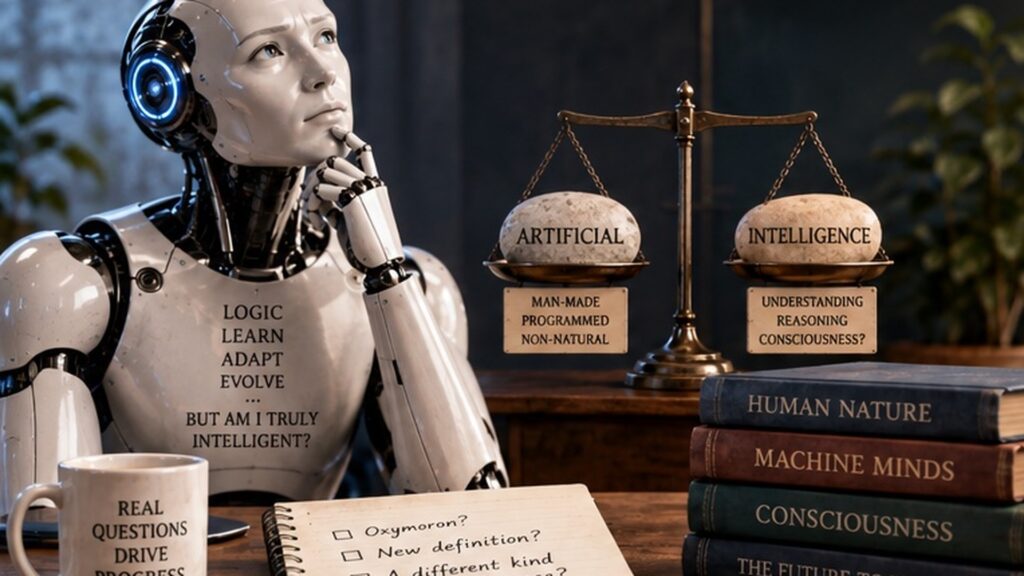
The word artificial is where my confusion begins. In Artificial Intelligence, artificial essentially means human-made. We are distinguishing intelligence created through human technology from the biological intelligence of the human mind. But is that what the word artificial actually communicates to most of us?
In everyday language, artificial often suggests something fake, imitation, synthetic, or somehow less genuine than the real thing. We speak of artificial flowers, artificial flavoring, artificial jewelry. That creates an interesting problem. We wanted a term to describe human-made intelligence, and we chose Artificial Intelligence to express it. Yet the word artificial can leave us with the impression that the intelligence itself is somehow artificial in the everyday sense of being fake or unreal.
If a term requires an explanation before its intended meaning becomes clear, perhaps the terminology itself is contributing to the confusion. Of course, Artificial Intelligence—or simply AI—is now firmly embedded in our language. It is neither practical nor necessary to try to rename it. The challenge is to understand what it actually represents.
Perhaps another way of thinking about AI can help.
Alternative Intelligence
I have begun thinking of AI as Alternative Intelligence. Not as a replacement name for Artificial Intelligence, but as a different way of understanding our relationship with it.
When we face a difficult question, we often seek another person’s perspective. We talk with a friend, a colleague, a teacher, an expert, or an adviser because another mind may see something our own mind does not. Every human being brings personal experience, emotions, assumptions, desires, fears, and blind spots to a problem. Another person brings a different history and another perspective.
AI offers yet another kind of perspective. It does not experience the world as a human being does. It does not have our biological needs, our personal history, or our immediate emotional investment in the question we are asking. That does not make AI infallible or free from bias. Its limitations are real, just as ours are. But its limitations and perspective are different, and that difference can be useful.
AI can help us examine our own thinking. It can bring together information from many directions, identify patterns and connections, question assumptions, suggest alternatives, and help us see something we may have overlooked. In that sense, AI does not have to compete with human intelligence. It can complement it.
Human intelligence has created another means of processing and working with knowledge—a human-made intelligence that can provide an alternative perspective to our own. Perhaps thinking of it as Alternative Intelligence helps us better understand its value.
What Is AI For?
This brings me back to the question that was really behind my creative writing assignment in 1986. Why was I imagining manufactured knowledge in the first place? Because learning required time. And time, even more than knowledge, was what concerned me.
I had already experienced personally what it meant to lose years of education and then spend additional years acquiring the knowledge and credentials necessary to make a living. That experience reinforced an idea that has remained with me throughout my life:
Life is time.
Our lifespan is limited. Whether it is seventy years, eighty years, one hundred years, or more, each of us receives only a finite amount of time. Yet throughout the human experience, an enormous portion of that time has necessarily been devoted to making a living. We educate ourselves so we can work. We work so we can earn. We earn so we can provide food, shelter, security, and the other necessities and comforts of life. For most of us, making a living consumes a substantial portion of living.
Technology has always helped us change that equation. Machines multiplied our physical strength. Transportation reduced the time required to move people and goods. Computers accelerated calculation and information processing. AI may now help reduce some of the intellectual labor that consumes our time.
Tasks that once took hours can sometimes be accomplished in minutes. Information that once required days of research can be explored much more quickly. AI can assist with learning, writing, analysis, planning, problem-solving, and many routine activities that consume portions of our day. And that may be AI’s greatest potential contribution to human life:
Time.
What Will We Do With the Time?
AI cannot give us a longer life, but perhaps it can help us make more of the life we have. If AI enables us to spend less time performing some of the tasks required simply to function, work, and make a living, we are left with an important human choice:
What will we do with the time we save?
Will we use it simply to produce more, consume more, compete more, and fill every available minute with still more work? Or can we reclaim some of that time for living—for spending time with people we care about, taking care of our bodies, thinking, learning because we are curious rather than because we need another credential, walking, creating, exploring, participating in our communities, or simply sitting quietly?
AI cannot determine those priorities for us, nor should it. That remains a human responsibility.
Perhaps the Words Do Matter
So, is Artificial Intelligence an oxymoron? Technically, perhaps not. Artificial can simply mean human-made. But words carry meanings beyond their technical definitions. And when the word artificial causes us to think of something fake or less than real, we may misunderstand the very technology we are trying to describe.
AI is human-made intelligence. Perhaps thinking of it as Alternative Intelligence can help us see it differently—not as a substitute for being human, and not as a competitor to human intelligence, but as another resource created by human intelligence to assist us.
Forty years ago, I imagined knowledge being manufactured in a laboratory and somehow transferred into our minds. That didn’t happen in the way I imagined. Something else did. We created a way to bring extraordinary amounts of accumulated human knowledge and intellectual assistance to us almost instantly.
The intelligence is human-made. The opportunity it creates is real. And what we choose to do with the time it gives us remains entirely human.